Validating Forensic Tools, Output Images, and Other Data
Forensic video technicians and analysts utilize various hardware and software tools to acquire, interrogate, interpret, and present image-based evidence in the courtroom. When presenting their evidence in court, technicians and analysts must be able to justify their reliance upon their chosen tools and must be able to articulate why the court should have...
CCTV Video Authentication Case Study: Did the Prosecution Do Enough?
CCTV surveillance video is often relied upon by the prosecution to establish essential facts in a case. To achieve admissibility, counsel for the prosecution must lead sufficient authentication foundation evidence. If the defence takes issue with the evidence led, they can argue that the prosecution has not met its burden. This case summary...
International Criminal Court Delays Judgment in Al Hassan Case
The International Criminal Court (ICC) in The Hague, Netherlands was scheduled to deliver its judgement in the case of Prosecutor v. Al Hassan on January 18, 2024. From an image-based evidence perspective, this case is significant because the prosecution relied upon advanced visual representations of key location evidence as part of its case...

Advanced Visual Representations in International Criminal Prosecutions
The International Criminal Court (ICC) in The Hague, Netherlands will soon deliver its judgement in the case of Prosecutor v. Al Hassan. From an image-based evidence perspective, this case is significant because the prosecution relied upon advanced visual representations of key location evidence as part of its case and presented the testimony of...
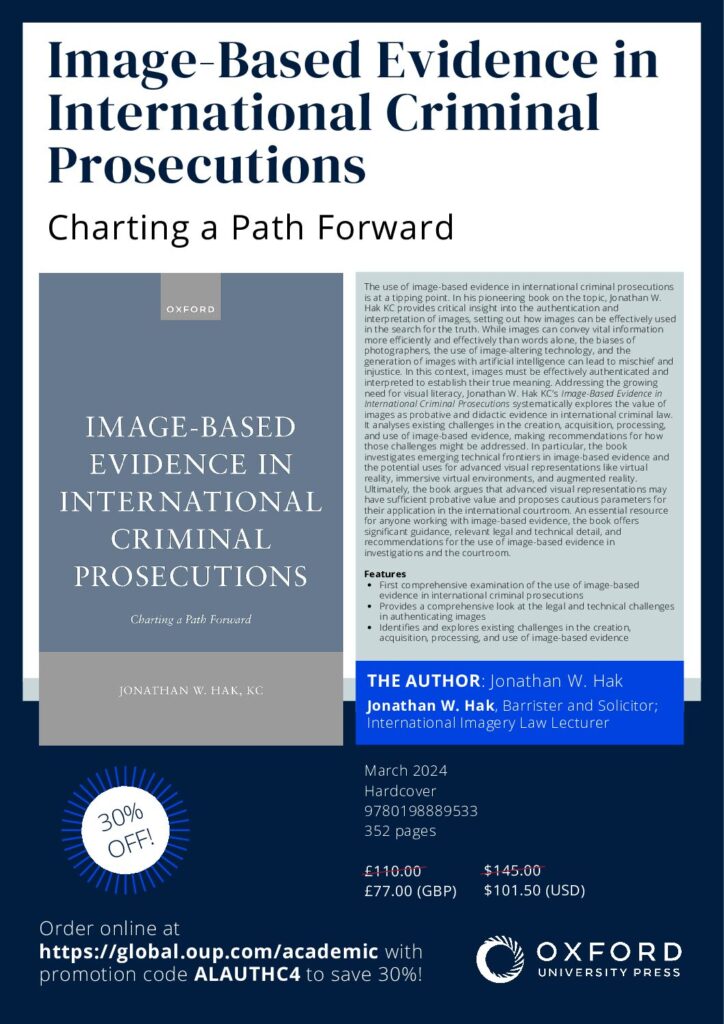
“Image-Based Evidence in International Criminal Prosecutions: Charting a Path Forward” is available for purchase!
After many years of leading and relying upon image-based evidence in the courtroom, teaching international imagery law in several countries, and recently being awarded a PhD from Leiden University in the Netherlands on the use of non-textual evidence in international criminal prosecutions, I am pleased to announce that my book Image-Based Evidence in...
The Search for the Truth in Open Source Evidence: Challenges, Limitations, and Opportunities
Open source image-based evidence is a key source of potentially valuable evidence in international and national criminal investigations and prosecutions. However, there are significant challenges and limitations involved in the use of this free-range evidence. I spoke about the use of open source image-based evidence at a conference hosted by the Inner Temple...
Artificial Intelligence and Images: Investigative Tool or Evidence?
Artificial intelligence (AI) is in the news almost daily. It is being used in many contexts, some for salutary purposes, and some for more insidious reasons. When considering the intersection of AI and image-based evidence in criminal investigations and prosecutions, it is important to draw a distinction between the use of AI for...
Opposing Experts Diverge on Video Authentication: Case Study
An interesting surveillance video authentication case involving opposing experts found its way to the Appellate Division of the Superior Court of New Jersey. This article reviews the facts that were considered by the trial judge, the expert evidence presented, the authentication ruling of the trial judge, and the appellate review of that ruling....
Troubling Trend in Expert Image Comparison Evidence in Canada?
A recent Canadian case has highlighted an apparent issue that is affecting how some courts are assessing the probative value and admissibility of expert image comparison evidence. This article reviews this recent case in the context of previous rulings and recommends how image comparison evidence should be presented to the court by experts...
Cognitive Bias and Forensic Experts: Preserving Independence and Learning to Say No
Cognitive bias among forensic experts is a significant issue that can lead to unsupportable conclusions and miscarriages of justice when undetected. It may also result in the exclusion of evidence at trial that one of the parties was relying upon as a method of proof. Such was the case in a June 2023...